

Water and Nature: From Crisis Management to Economic Foresight
France’s devastating summer drought proves that standard climate models are no longer enough; risk managers must now precisely quantify their exposure to a critically vulnerable resource.

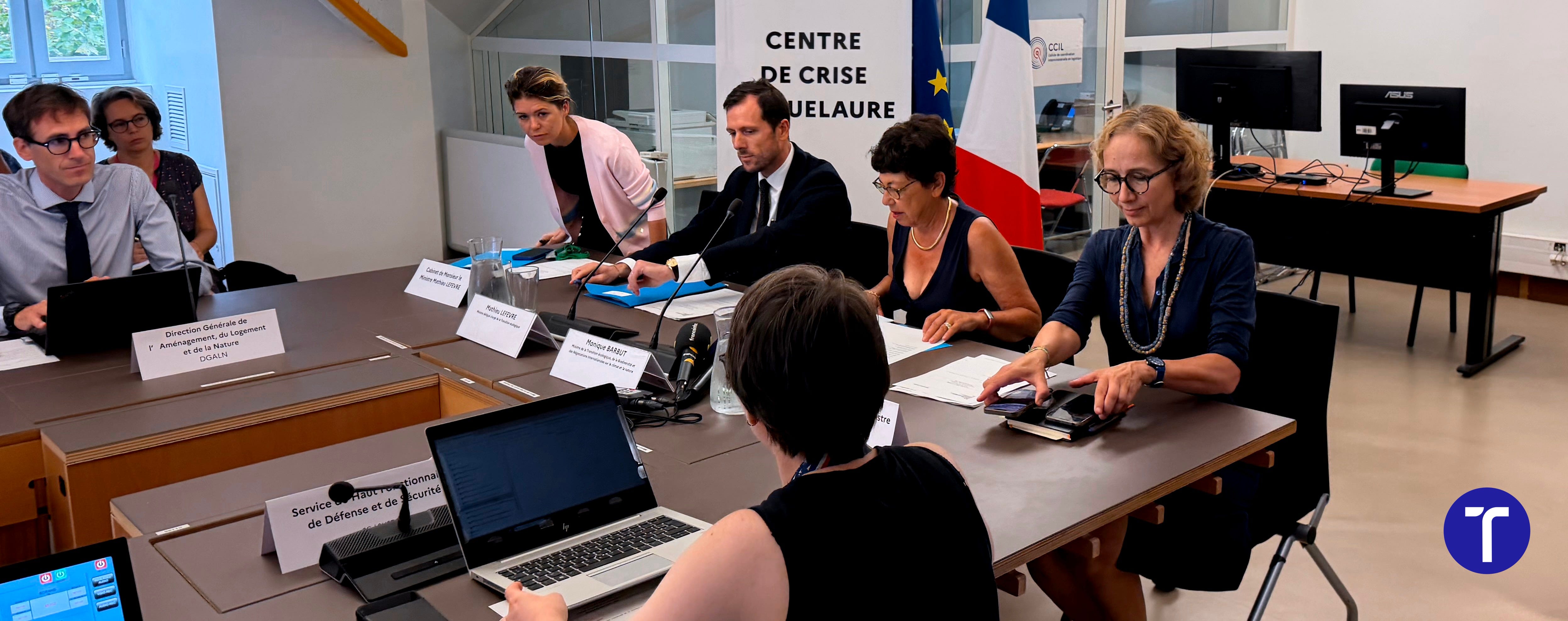
This summer, faced with a proliferation of heatwaves and the onset of a severe drought, the French government is scrambling to deploy emergency measures.
At a meeting on July 15, Monique Barbut, Minister for the Ecological Transition, delivered an unequivocal assessment: “We are experiencing a drought of exceptional magnitude, both in terms of its early onset and its intensity … What makes the situation particularly worrying is that it comes despite spring rainfall having been broadly within seasonal norms.” She concluded: “Today, the entire water cycle is being disrupted.”
Météo France [Ed. French national meteorological service] confirmed that the country is grappling with the worst drought on record: “By July 15, soil moisture levels have dropped exceptionally low, surpassing the historic lows observed in 1976, 2022, and 2025 at the same date. ... Rising temperatures are accelerating soil evaporation and exacerbating water deficits.”
As early as July 9, Agriculture Minister Annie Genevard warned of a predictable “yield crisis,” a direct consequence of extreme heat and restricted access to fertilizers.
A Belated Awakening
The proliferation of emergency response plans is inversely proportional to states’ capacity for long-term planning, despite repeated warnings from multilateral institutions.
Indeed, upon taking office in 2006, former OECD Secretary-General Angel Gurría established water management as a core strategic pillar1. It was under his stewardship that the OECD Principles on Water Governance were drafted.
Notably, the United Nations failed to convene a single summit exclusively dedicated to water between the 1977 Mar del Plata conference and the 2023 New York summit. The Global Water Action Agenda adopted at the end of the 2023 conference aimed to address structural backlogs in resource management, even as 2050 projections already estimated that half of the world’s population would face acute or temporary water stress. Outlooks for the European Union were equally sobering. “About 35% of the EU’s land area will be under high water stress by the 2070s, by which time the number of additional people affected (compared to 2007) is expected to be 16 to 44 million,” the UNECE (UN Economic Commission for Europe) noted at the time2.
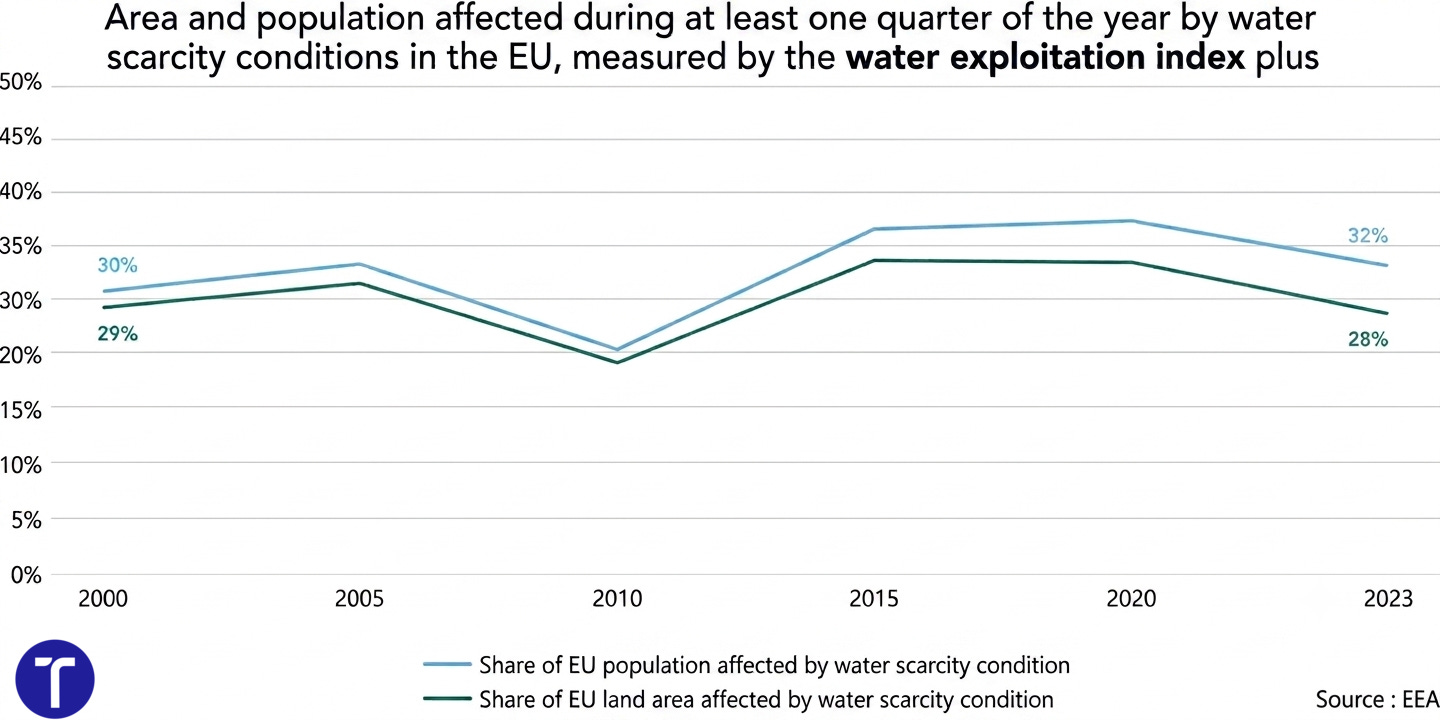
The integration of new variables has since led to upward revisions of these estimates. The European Environment Agency (EEA) now estimates that, on average, “about 30% of EU territory and 33% of the population are affected each year.” The institution added that “given ... a worsening trend since 2010, a reduction in water scarcity by 2030 appears unlikely.”
Projections for France were made public in June 2025. Looking ahead to 2050, the combined effect of dwindling supply and surging demand—driven by heat-induced agricultural irrigation, industrial needs, and demographic growth—is expected to worsen hydrological conditions in nearly 90% of French watersheds during the month of July, according to the Haut-Commissariat à la Stratégie et au Plan [Ed. the French government’s strategic planning and forecasting agency].
Quantifying Double Materiality
While managing the French drought requires immediate financial relief, supporting economic actors over the medium and long term demands a radical overhaul of risk modeling. Current methodologies integrate climate factors but struggle to capture risks related to biodiversity and the loss of ecosystem services.
The Research Chair on the “Economic and Financial Modeling of Risks Related to Nature,” launched on July 6 at the initiative of the Banque de France, aims to bridge this analytical deficit. It seeks to dismantle the traditional approach that either ignores or aggregates nature’s services within corporate balance sheets.
According to Lionel Fontagné (Paris School of Economics - PSE), this initiative is unprecedented and positions French research at the forefront of the field.
“The primary objective of the Chair is to accurately quantify the bidirectional interactions between ecosystems and the financial sphere. On one hand, it will measure the adverse impacts of environmental degradation on economic activity and financial stability. Conversely, it will assess how economic activity itself drives biodiversity loss - a concept known within European regulatory bodies as ‘double materiality’,” explains Laurent Clerc, Deputy Director-General for Statistics, Economics, and International Business at the Banque de France. For Clerc, the Chair is primarily “a vehicle for companies to finally integrate the vulnerabilities directly tied to the living world into their corporate strategies and risk management.”
This approach extends the work of the Network for Greening the Financial System (NGFS), which has been working since 2022 to estimate the macroeconomic impacts of nature degradation globally3. This Chair, in partnership with the NGFS, aims to translate theoretical concepts and environmental indicators into actionable tools for operational decision-making.
One of the research program’s immediate workstreams will be to develop operational financial metrics for risk management by adapting existing macroeconomic models, such as SCALE (developed at École Polytechnique) or SNOW (developed at PSE). “Our goal is to reintroduce nature into production functions,” says Lionel Fontagné, noting that physical events, such as a lack of precipitation, have “inevitable consequences” for financial and insurance systems.
A Systemic Risk Finally Identified
Water has emerged as the priority issue for monetary authorities and researchers alike. Identified as the most critical risk in terms of both probability and impact, water stress is no longer confined to traditionally exposed sectors; it now threatens the stability of the entire French and European economic fabric.
According to the Banque de France, losses stemming solely from water restrictions during periods of hydric stress could wipe out up to 7% of total revenue for certain domestic industrial companies. The outlook across the EU is equally alarming: the European Central Bank (ECB) estimates that 72% of non-financial corporations in the euro area are highly dependent on at least one ecosystem service, with water ranking at the top of these dependencies.
To compensate for the lack of granular, on-the-ground data - which companies are invited to share confidentially with researchers - artificial intelligence will be deployed to reconstruct supply-chain environmental footprints, including deforestation. CREST (Center for Research in Economics and Statistics) is spearheading this methodological module.
“In fact, nature is an unpriced input in traditional production functions. As it deteriorates, we are witnessing a structural decline in the productive capacity of whole sectors of the economy,” summarizes Ivan Odonnat, Director General for Financial Stability and Operations at the Banque de France.
The research agenda incorporates a strong forecasting dimension. It outlines transition scenarios for 2040, 2050, and 2060 - such as the large-scale adoption of agroecology or stringent conservation policies for natural habitats. These will be run through the models to calculate their structural impacts on employment, inflation, and sectoral value added.
“Through this research, we hope to improve market participants’ understanding of the risks they face, and contribute to major international initiatives,” notes Laurent Clerc, who hopes to see other public and private institutions join the Chair’s work and funding. To serve the public good, all datasets will be open access and made freely available. For investors and insurers, the stakes extend far beyond the academic realm. At risk is their very ability to anticipate losses comparable to those already recorded in France - up to €18 billion for the industrial sector4 - and to price them into their asset allocation and hedging decisions.
“Pays émergents - Les enjeux des investissements en infrastructures” - Annick Masounave, Banque Stratégie, February 2007
“L’eau accède à un statut de ressource critique” - Annick Masounave, L’Agefi, 23 mars 2023
“Les banques centrales publient une grille d’analyse sur la nature” - Annick Masounave, L’Agefi, 7 septembre 2023
Source: Banque de France