

The Moral Imperative of Climate: Breaking Societal Bubbles
In his latest work, Frederic Samama proposes a "shock of representation" to reinvent our moral relationship with nature and bridge the gap between economic interest and universal responsibility.

Inaction on climate change is a baffling enigma. We have understood the science for fifty years and felt its impact for at least ten. Having created the very problem that now endangers our survival as a species, we are left with a haunting question: why can we not find the will to act?
Yet, this mobilization was possible with the Covid-19 pandemic, or the ozone layer depletion. What makes this challenge different from the others?
The explanations are many, but I contend that we are locked into three societal “bubbles”—intellectual analogues to financial bubbles—where overconfidence in our models blinds us to reality.
To understand this, take the example of a rat in a maze with a piece of cheese. Initially, it wanders, exploring its surroundings. Then, it forges a specific route. Finally, it begins to follow that path mechanically, driven by the absolute confidence that it will find its food at the end. It becomes a prisoner of its own successful pattern.
We have navigated three “cheese moments”: the exploitation of natural resources through modern science; the neoliberal era’s global mobilization of human labor; and, finally, the rise of the modeling bubble. What began as a functional instrument for survival—modeling environments to better exploit them—has been elevated into a finality.
These systemic bubbles now create a profound impasse, stifling the moral urgency required to confront the climate emergency.
But didn’t the “neoliberal bubble” create the conditions for the economic and cultural rise of Europe?
This theme lies at the heart of my argument. In 17th and 18th-century Europe, thinkers—from Machiavelli and Spinoza to Adam Smith—sought new mechanisms to break the cycle of incessant warfare, all waged in the name of religion and morality. They launched a historical experiment unique in the world: the creation of instruments for human coordination that did not rely on moral or religious dictates. This birthed the modern state through the Treaty of Westphalia, alongside capitalism—both rooted in the then-emerging concept of self-interest.
The system has been an overwhelming success: life expectancy has surged, hundreds of millions have been lifted out of poverty, and billions have escaped illiteracy.
How does the same bubble explain today the methodological inability of the financial sector to address climate change, particularly in its investment decisions?
We engineered a system that is, by design, amoral. Yet the climate crisis resides within the domain of ethics and action; it is a matter of safeguarding both the vulnerable and future generations. The economic sphere has expanded so aggressively that it has effectively cannibalized the moral one, leading to a fundamental category error: the attempt to resolve an ethical breakdown through financial mechanisms never intended for such a task. Addressing this reality requires an entirely different set of instruments.
If we follow your reasoning, does modeling lead to a misleading representation of the world?
Modeling was originally conceived as a tool for survival—a practical means to secure the resources fundamental to life. Today, however, the model has become an end in itself. We must restore the tangible priority of resource access to the core of our decision-making.
How can we extract ourselves from this system of bubbles?
It is a daunting task. By definition, every bubble eventually bursts—and for the climate, that rupture translates into human catastrophe.
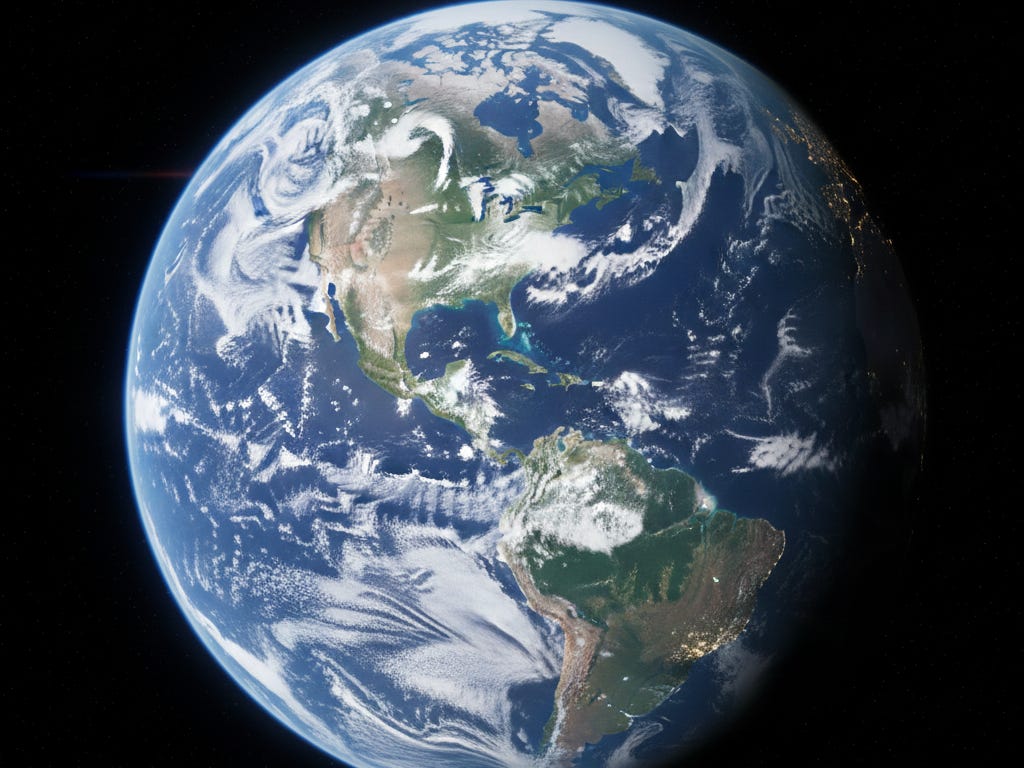
This is why I propose a “shock of representation” to catalyze a new value system, as human cooperation is fundamentally built upon the values we hold. Consider the perspective of astronauts viewing Earth from space; they all describe a radical shift in consciousness, a phenomenon driven by three key mechanisms.
First, they perceived the fragility of the Earth. When faced with the fragile, our intrinsic nature is to “take care”—a concept Levinas established as the very foundation of ethics. Next, they found the Earth beautiful, activating Kant’s notion of “disinterested beauty,” which detaches us from personal interest and “prepares us for morality.” Finally, this vantage point reminds us of the uniqueness of life within the void, echoing Spinoza’s insight that “we are nature.” Observing the Earth—beautiful, fragile, and alive amidst the frozen immensity of space—puts us back in our place: we are not above nature, but a part of it.
It is not a question of sending eight billion people into orbit, but of re-anchoring ourselves in the natural world. This could begin in schools, by teaching how certain plants emit gases to ward off predators or exploring the complex social and family codes of animals.
What solution do you foresee to create cooperation around the issue of climate?
The imperative now is to reconstruct a framework of common values. In the past, religions enabled large-scale cooperation, yet their competition prevented them from reaching a global consensus. Capitalism succeeded in going global, but it did so through an individualism that erodes our moral compass.
Today, the climate could become that universal value of responsibility. This is perhaps its most vital role: to reinvent our relationship with nature and, consequently, our bonds with each other. In a world drifting toward fragmentation, the climate is not just a colossal threat; it is a profound opportunity.
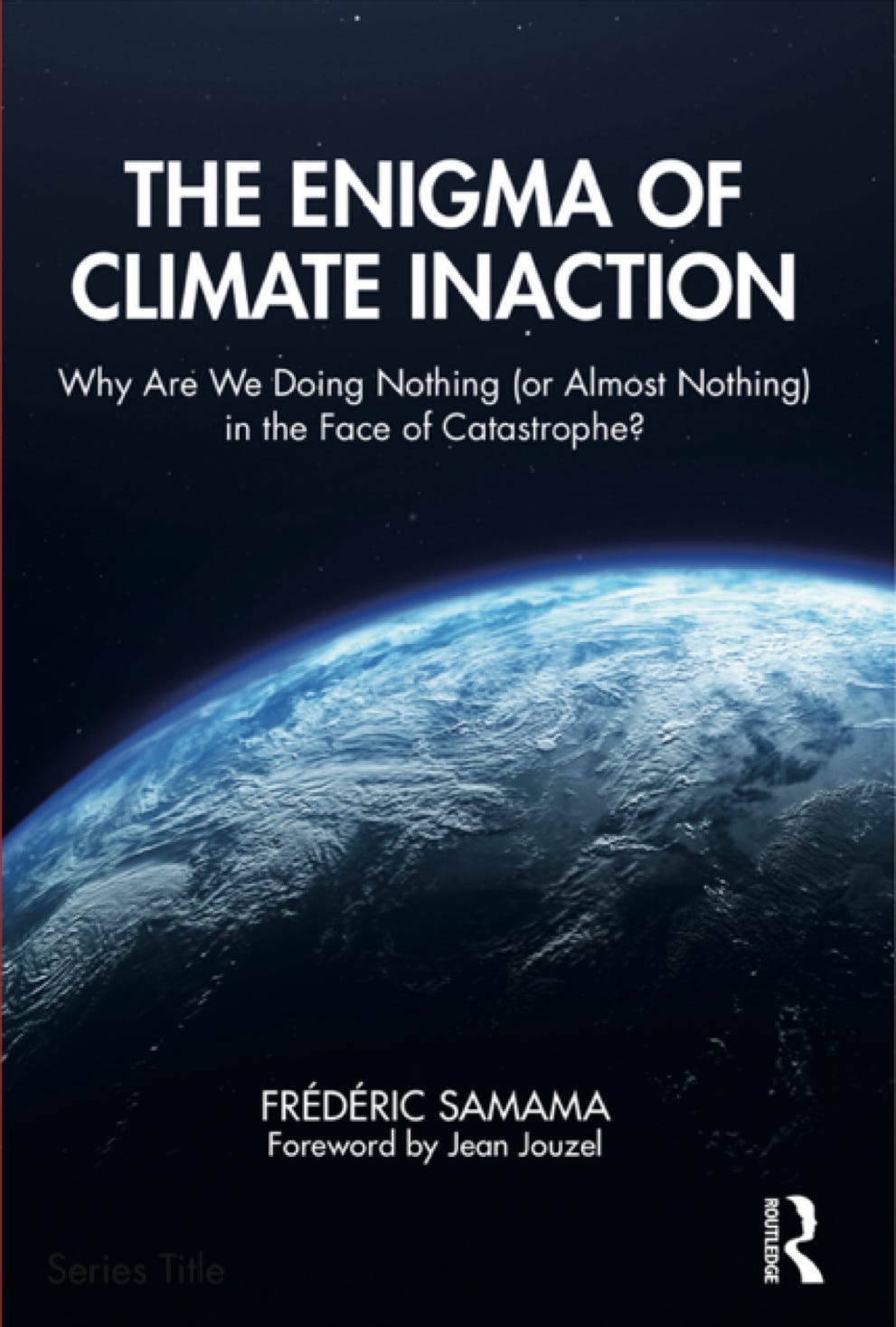
Frédéric Samama is a global expert in sustainable finance. Holding a PhD in Economics and a degree in Philosophy, he also teaches at Sciences Po Paris. Co-author of Sovereign Wealth Funds and Long-Term Investing with Patrick Bolton and Nobel laureate Joseph Stiglitz, he recently released The Enigma of Climate Inaction (Routledge), the expanded English edition of Archéologie de l’inaction (Hermann, 2024).