

Beyond Tariffs: India’s Strategic Pivot in a Fragmented Global Order
By orchestrating a calculated market opening, New Delhi aims to leverage global partnerships to fuel its overarching ambition: long-term industrial sovereignty.

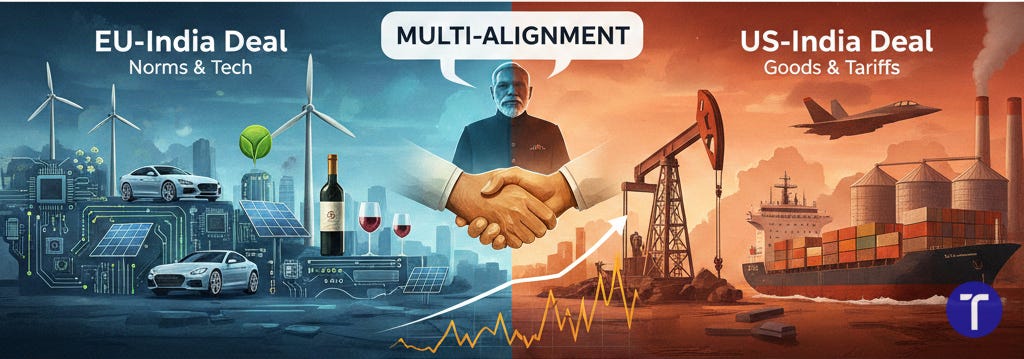
In 2025, the Indian economy faced a dual-front squeeze as it grappled with shifting regulatory barriers in the EU and aggressive tariff hikes in the United States..
On the American front, the hike in customs duties - reaching up to 50% in August 2025 - severely hampered key export-oriented segments of the Indian economy. The textile sector, which maintains a 29% revenue exposure to the U.S. and remains the country’s second-largest employer (accounting for 45 million direct and 60 million indirect jobs), saw export volumes plummet by 25%.
Simultaneously, Indian steel exports to the EU dropped from $7.4 billion to $5.5 billion between 2023 and 2025 - a 25% contraction. This downturn is largely attributed to industrial players pre-emptively adjusting to the Carbon Border Adjustment Mechanism (CBAM): a framework projected to erode corporate margins by 15% to 22% upon full implementation.
To secure its market access, New Delhi has finalized two major trade agreements in record time.
Washington: The Diplomacy of Constraint
The deal with the United States came at a high price, requiring significant concessions. The most geopolitically and economically charged of these is the cessation of Russian oil imports. While New Delhi has not officially confirmed this commitment, the pivot is already reflected in the data: imports of U.S. crude surged by over 70% between September and November 2025 (source: BNP Paribas Research).
Prime Minister Narendra Modi aims to absorb the premium—estimated at $10–$12 per barrel at current spot prices—through a rebound in exports facilitated by the trade deal. He argues the agreement provides a critical regional competitive advantage, bringing India’s average effective tariff rate down from 35.1% to 15.6%, compared to 19% for Vietnam and 16.2% for Thailand, while Chinese imports remain disadvantaged by a 34% duty.
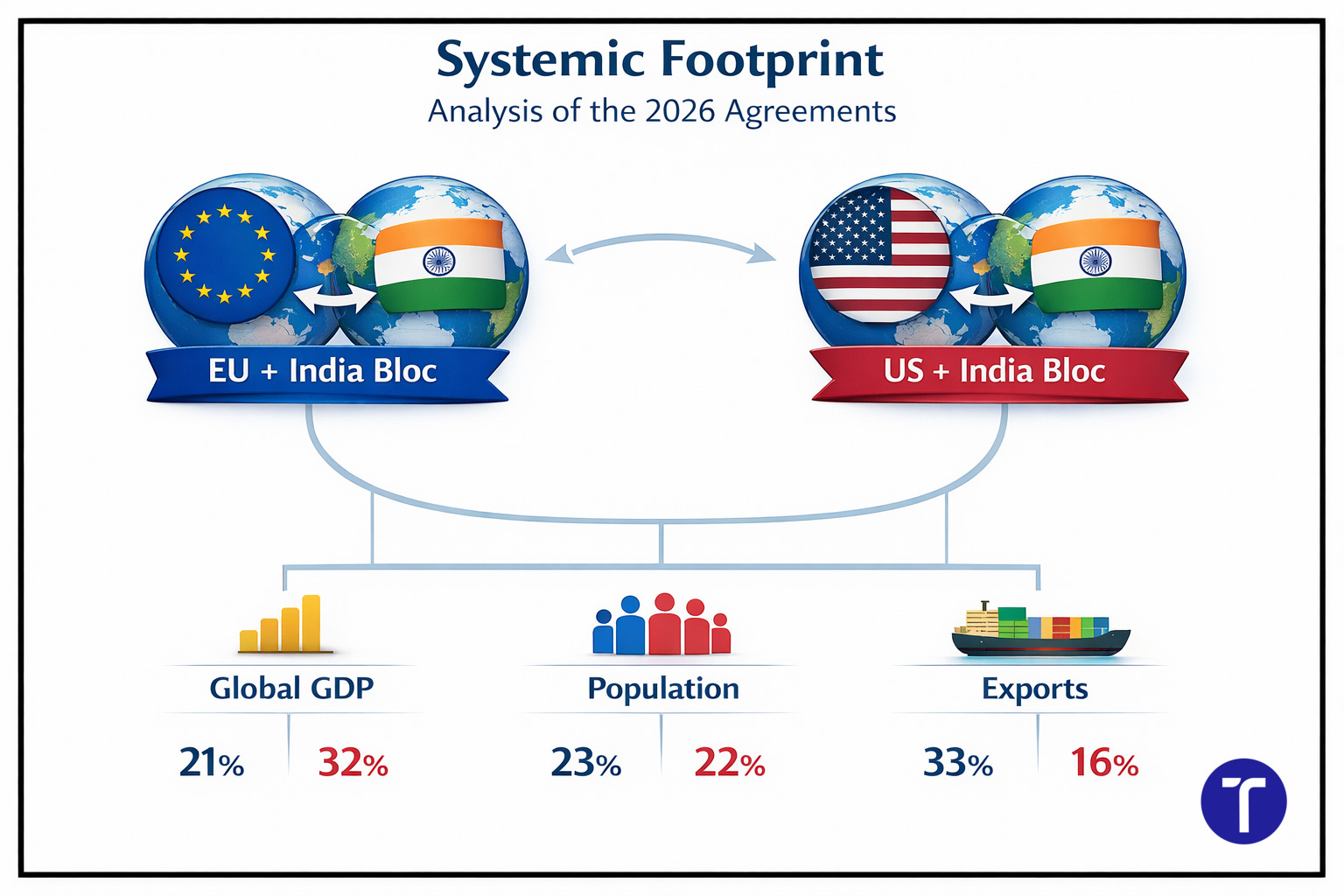
However, domestic opposition has labeled the move a “capitulation,” accusing the Prime Minister of sacrificing strategic autonomy under pressure from the White House. The agricultural sector, which contributes over 16% to GDP and employs 45% of the workforce, fears an influx of cheap American agricultural commodities. The Samyukt Kisan Morcha (SKM) union has called for a day of protest on February 12, 2026. As of today, the national strike is causing significant logistical bottlenecks across Northern India, as protesters demand binding guarantees that the U.S. trade pact will not undermine domestic Minimum Support Price (MSP) mechanisms.
Defending the pact, Commerce and Industry Minister Piyush Goyal emphasized that the dairy sector remains 100% excluded, maintaining a “red line“ for New Delhi. He argued this interim pact opens a $30 trillion market to Indian exporters, with strategic sectors like basmati rice, tea, and spices gaining zero or highly preferential access. The final framework of the treaty is expected by mid-March 2026.
The EU-India Pact: A Blueprint for Structural Synergy
In contrast, the relationship with Brussels is framed as a long-term strategic alignment. Following two decades of negotiations and a decisive acceleration in mid-2025, the agreement signed on January 27, 2026, formalizes a structural complementarity.
“India exports labour-intensive, downstream and processing-based goods, while the European Union supplies capital goods, advanced technology and industrial inputs,“ summarizes the Indian think tank Global Trade Research Initiative (GTRI).
This synergy aims to lower production costs without undermining the domestic industrial base. India plans to phase out or reduce tariffs on 96.6% of EU exports, while the EU will do the same for 99.5% of Indian products. The European Commission anticipates annual tariff savings of $4.7 billion, with exports projected to double by 2032. According to Allianz Research, France and Germany stand as the primary beneficiaries.
Furthermore, India’s increased involvement in Horizon Europe, announced February 6, signals that the partnership has evolved beyond mere trade into the co-development of “frontier” technologies like green hydrogen and AI, alongside regulatory convergence with the 22 associated nations (see below).
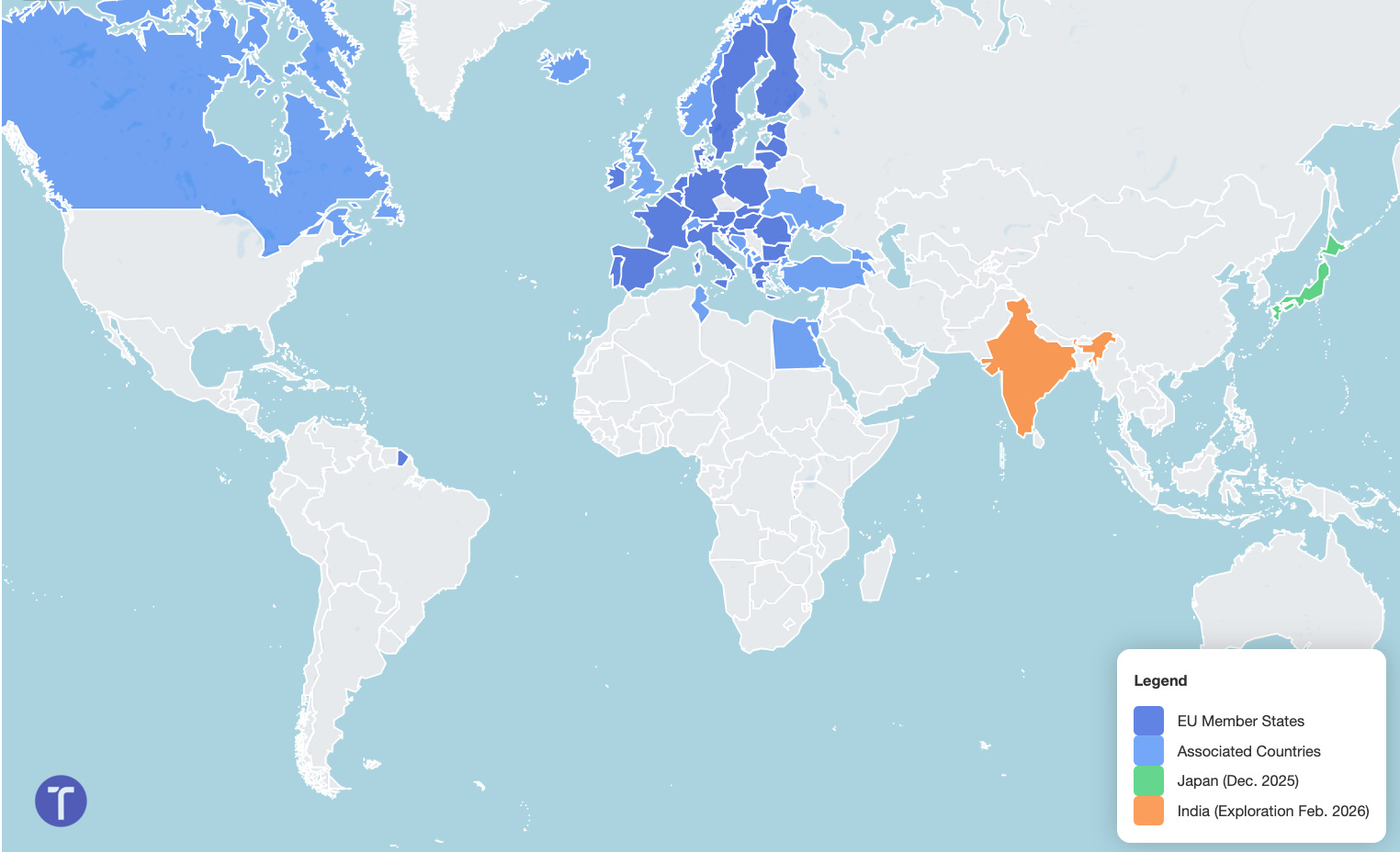
While the EU agreement has not been immune to opposition criticism, it is built on a logic of complementarity that experts at the GTRI describe as “economically rational.” According to the Kiel Institute, the treaty is set to boost the GDP of both blocs by 0.12% to 0.13% by 2030. Conversely, IRIS (The French Institute for International and Strategic Affairs) takes a more critical stance, highlighting the deal’s numerous “grey areas”.
The Carbon Tax: Transforming a Diplomatic Hurdle into Leverage?
In this ‘next-generation’ agreement, as characterized by a Member of the European Parliament, key red lines remained intact. For the EU, waiving the Carbon Border Adjustment Mechanism (CBAM)—which transitioned to its definitive payment phase on January 1, 2026—was non-negotiable. The levy has been a source of persistent diplomatic strain since 2021, as evidenced by India’s 29 official protests before the WTO (World Trade Organization).
However, the final negotiations established a phased rollout. Nearly half of Indian steel exports will retain customs duty exemptions while beginning their incremental alignment with the CBAM framework. Furthermore, the EU will invest €500 million in 2026–2027 to support the decarbonization of the Indian steel industry, facilitating the transition from coal to low-carbon technologies.
Crucially, New Delhi secured the activation of Article 9 of the EU regulation. By recognizing the equivalence between India’s Carbon Credit Trading Scheme (CCTS) and the EU’s Emissions Trading System (ETS), India will retain carbon tax revenues domestically to finance its energy transition.
US-India: A Regime of Reversible Favors
Economic research institutes broadly agree: the Washington-New Delhi pact follows a logic of short-termism. Designed primarily to reduce the U.S. trade deficit, the deal focuses on immediate market openings and serves largely as “damage control” following the 2025 tariff wars.
India has pledged to double its imports of American goods over five years—from $43 billion to $100 billion—a target many analysts regard as overly ambitious. This outlook is further clouded by a reversibility clause, which maintains a climate of chronic uncertainty for Indian firms.
“The U.S.-India agreement, at least at this point, contains some elastic words that will allow India to do less than Trump says it promised, although that will prompt more threats and bullying,” anticipates the CSIS (Center for Strategic & International Studies).
“The Greenland episode offers a clear lesson to India: trade deals with the U.S. are not a shield against coercion. Tariffs and sanctions can be reimposed regardless of agreements.” GTRI, January 2026.
The vulnerability of this bilateral relationship was highlighted on February 9, when the Indian textile industry discovered a preferential advantage granted to Bangladesh. “Bangladeshi garment exporters using US cotton can ship qualifying products to the US at zero tariff, while the broader tariff on Bangladeshi exports stands at 19 per cent. India has secured no such carve-out,” as highlighted by the Indian daily BusinessLine.
This setback underscores the inherent fragility of a relationship where Washington dispenses favors on an ad hoc basis to serve its own interests, all while strictly enforcing ‘Buy American’ mandates. As of 2026, the liberalization of the Indian market is well underway, but preserving economic sovereignty remains a high-stakes balancing act.